Harvard graduate students · 2026–2027

Build experiments and theory together.

Our rotations ask how biological histories determine future fate. Enter by building a measurement, inventing an inference method, testing a control strategy—or connecting all three.

01

One clear question

Each rotation is scoped around a result that can be reached during the rotation: a measurement, proof of principle, algorithm, or model.

02

Your entry point

You may focus on experiment, mathematics, or computation. You will work closely with people approaching the same question from the other sides.

03

Room to learn

You do not need to arrive with a project proposal or expertise in every method. We shape the project around your interests and background.

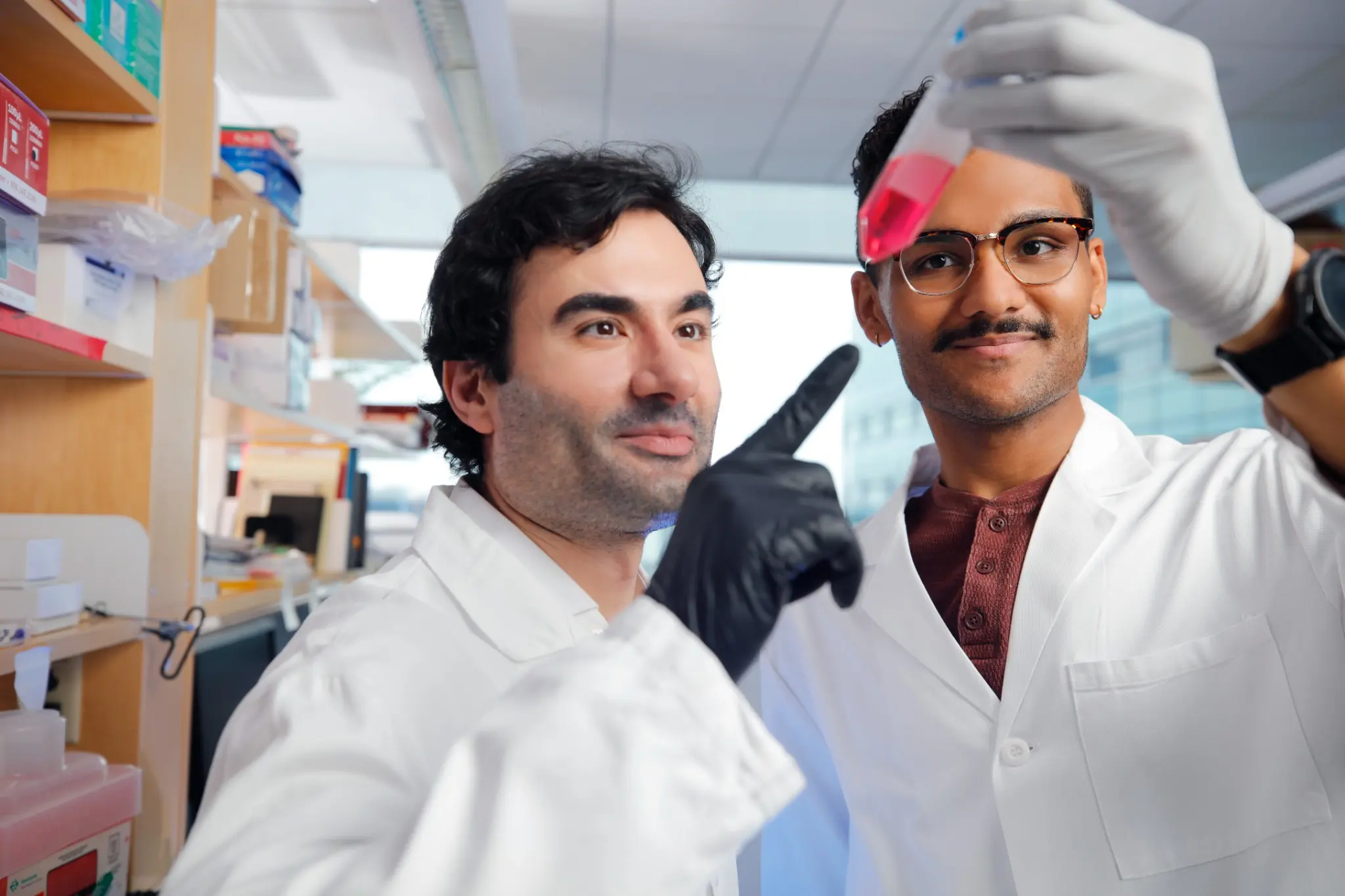
Sahand Hormoz and a lab member examining a cell culture flask together
A rotation is a collaboration from the first question.

Life in the lab

Bring one way of thinking. Learn several more.

Rotation students work directly with Sahand and with lab members whose training may be very different from their own. An experiment can expose the need for new mathematics; a model can reveal the measurement that must be built next.

Read our mentoring philosophy

Open directions

Choose the history you want to read.

01

Record signaling histories in DNA

Can a cell’s genome preserve not only its ancestry, but also the signals it experienced?

We are building a new generation of molecular recorders using base and prime editors. These systems will record developmental and inflammatory signals without making double-strand breaks.

A rotation student could

  • Design and test a signaling recorder in cultured mammalian cells.
  • Measure its writing rate, specificity, and dynamic range.
  • Develop models that reconstruct signaling histories from incomplete DNA records.
  • Use simulations to determine which recorder designs preserve the most useful information.
Synthetic biologyGenome engineeringProbabilistic modelingSingle-cell sequencing
02

Infer hidden states from cellular family trees

Can the behavior of related cells reveal states that we cannot measure directly?

Our mammalian mother machine follows cells and their descendants for up to 30 generations. We develop hidden Markov models on trees to recover the invisible states behind those movies.

A rotation student could

  • Analyze multigenerational movies of mammalian cells.
  • Test whether observed lineage correlations require a hidden state.
  • Extend hidden Markov models to continuous reporter trajectories.
  • Measure how perturbations change hidden-state dynamics.
Live-cell imagingMicrofluidicsStochastic processesDynamic programming
03

Reconstruct the origins of blood cancer

Can a blood sample collected today reveal when a cancer began decades earlier?

The frequencies of naturally occurring mutations contain a compressed record of clonal growth. We are developing the population-genetic theory needed to read that record.

A rotation student could

  • Develop models connecting mutation frequencies to clonal growth.
  • Infer the age and fitness of mutant clones from simulated or patient data.
  • Determine when age and fitness can be inferred separately.
  • Compare bulk-sequencing predictions with single-cell lineage trees.
Population geneticsStochastic processesStatistical inferenceCancer genomics
04

Control development in synthetic human embryos

Can we learn the sequence of states and signals that produces a tissue—and then recreate it?

We create synthetic embryos that break symmetry, form a body axis, and generate early tissue patterns. These systems let us observe and perturb developmental histories that cannot be studied directly in humans.

A rotation student could

  • Test how the timing of a developmental signal changes tissue fate.
  • Build live reporters for important developmental states.
  • Use lineage tracing to connect early cells to later descendants.
  • Develop feedback systems that respond to the state of the tissue.
Stem-cell biologyDevelopmentLive imagingFeedback control
05

Discover and control bacterial cell states

What does it mean for a bacterium to occupy a particular cell state?

We pair bacterial single-cell RNA sequencing with CRISPR perturbations to move from observing heterogeneity to identifying the regulatory programs that control it.

A rotation student could

  • Design and validate a probe panel for bacterial single-cell sequencing.
  • Test CRISPR perturbations of poorly characterized genes.
  • Identify cell states in high-dimensional expression data.
  • Determine which perturbations move bacteria between states.
Bacterial geneticsSingle-cell sequencingCRISPR screensCausal inference
06

Infer fitness landscapes from evolving viruses

Can complete viral genomes tell us which evolutionary paths are possible?

We recover full-length genomes from individual viruses and follow populations as they evolve in the laboratory. Complete genomes reveal which mutations arose together and how they interact.

A rotation student could

  • Validate methods for recovering full-length viral genomes.
  • Analyze combinations of mutations during experimental evolution.
  • Infer viral fitness from changes in sequence frequency.
  • Test whether inferred landscapes predict future trajectories.
Experimental evolutionSequencing technologyPopulation geneticsFitness landscapes
07

Learn developmental programs with automatic differentiation

Can a model learn the local rules that cause cells to build a particular tissue?

DiffeoMorph treats cells as independent agents and differentiates through the tissue they build. It learns the rules of movement, signaling, and interaction that generate a desired form.

A rotation student could

  • Build a differentiable model of cell movement, signaling, or fate choice.
  • Learn local rules that generate a target tissue structure.
  • Add biological constraints such as division, polarity, or signaling range.
  • Fit a differentiable model to lineage, imaging, or single-cell data.
Automatic differentiationOptimizationAgent-based modelsDevelopmental biology

You might be a good fit if

You want the method and the question to change each other.

  • Build an experiment because an important quantity cannot yet be measured.
  • Develop new mathematics because existing methods cannot answer the biological question.
  • Use models to design the next experiment, not only analyze the previous one.
  • Learn methods outside your current training.

Interested in rotating?

Tell us which questions pull you in.

Send Sahand a short email with your graduate program and year, when you hope to rotate, one or two projects that interest you, and whether you currently lean toward experiment, theory, computation, or a combination. No formal proposal is needed.

Email Sahand