Building independence
Scientific independence is learned gradually. It should not be demanded on the first day, nor postponed until the end of a PhD.
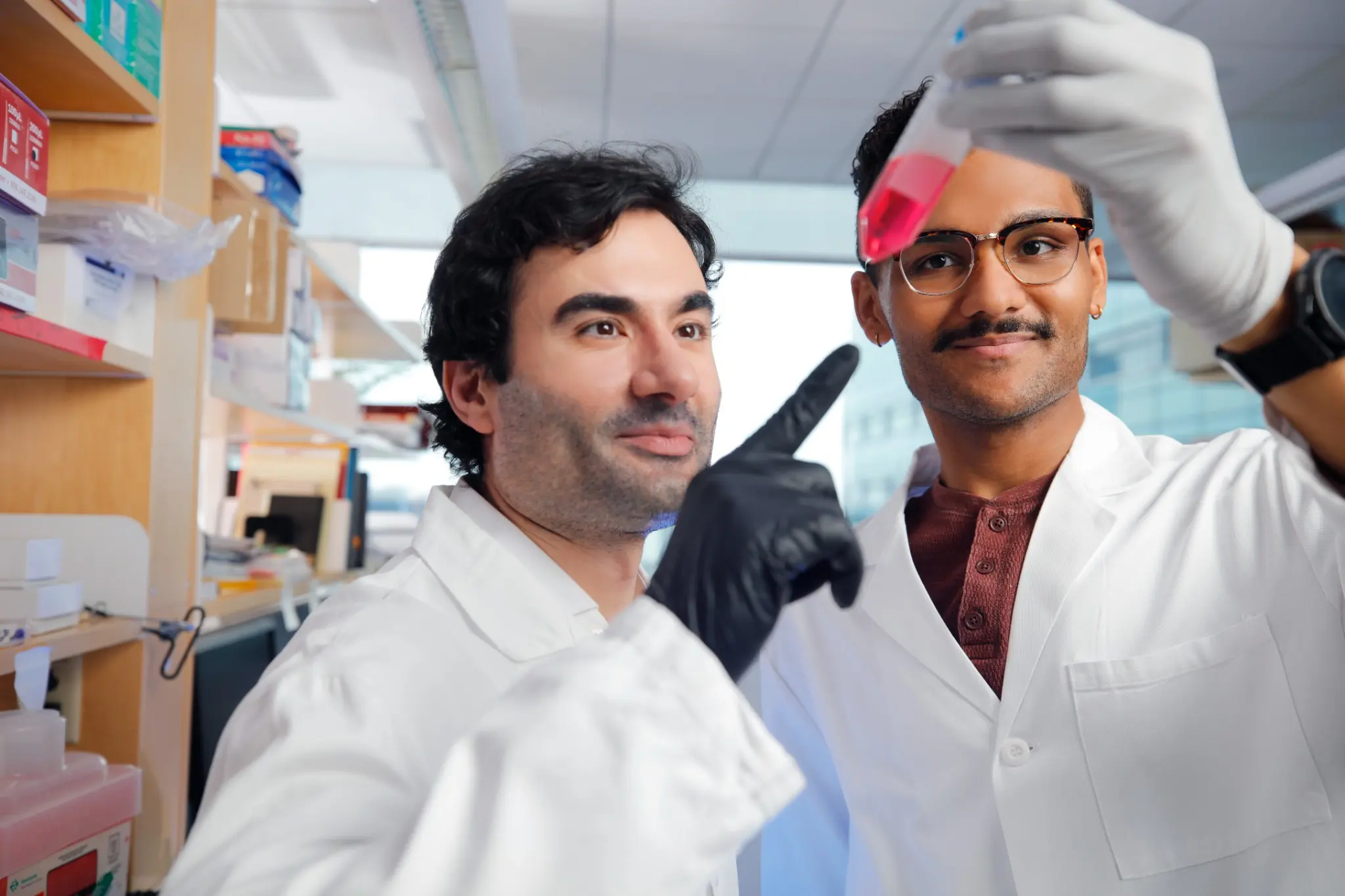
At the beginning of a project, I work closely with students to sharpen the question, identify decisive experiments, and build the skills they need. As the project develops, the student takes increasing ownership. My role shifts from helping design each step to challenging assumptions, identifying blind spots, and helping the student see further.
The goal is not for students to reproduce my way of thinking. Some of the best moments in mentoring occur when a student convinces me that I am wrong.
Choosing a project
A good project lies at the intersection of an important question, a tractable approach, and the student’s curiosity.
Projects often begin with a broad direction rather than a fixed sequence of experiments. A strong project should have a path to an early result, but enough depth to grow into something neither of us could have predicted at the start.
Students should understand why their project matters and have a genuine voice in where it goes. We revisit goals when experiments fail, new data appear, or a better question emerges.
How I advise
My job is to challenge and support each person in the lab.
I meet with trainees regularly. New projects and difficult periods usually benefit from close discussion. Mature projects often need more space. I try to give feedback that is direct, specific, and useful, and I expect students to question my suggestions when they disagree.
Students should never feel that they need to hide uncertainty or wait until they have solved a problem before asking for help. Honest conversations about failed experiments, incomplete analyses, and changing interests are part of doing good science.
Crossing boundaries
The most interesting biological questions rarely belong to a single discipline.
Our lab brings together experimental biology, synthetic biology, mathematics, physics, computation, and engineering. Experimental biologists have joined and learned to build models. Theorists have joined and become skilled experimentalists.
No one is expected to arrive as an expert in every area. A theorist should understand how the data were produced. An experimentalist should understand what the model assumes and what can be inferred from the measurement.
Risk, mistakes, and failure
Ambitious research involves uncertainty. Experiments fail. Models turn out to be unidentifiable. Compelling ideas prove to be wrong.
Failure is useful when we learn from it. We try to distinguish quickly between a technical failure, a flawed assumption, and a question that needs to be reformulated. A careful negative result can be more valuable than a positive result we do not understand.
Fearlessness does not mean being certain. It means being willing to confront uncertainty directly.
Working together
Lab members do not work for me. We work with one another.
This does not remove my responsibility as principal investigator. I am responsible for creating a healthy scientific environment, securing resources, giving honest feedback, resolving conflicts, and making sure that people receive fair credit and support.
We share ideas, methods, code, reagents, and unfinished work. Scientific disagreement is welcome. Personal disrespect is not. Everyone contributes to the culture of the lab.
Ownership, authorship, and credit
Students should have intellectual ownership of their work. They should present it, write about it, and become known for it.
Authorship and project ownership should be discussed early and revisited as contributions change. Credit should follow contribution.
Trainees should also receive credit for work that is easy to overlook: building shared technologies, developing software, mentoring others, and making a collaboration possible.
Careers
There is no single successful career after graduate school or a postdoctoral fellowship.
I work with trainees to identify the career they want and the experiences needed to pursue it. Some will pursue academic research. Others will find their best work in biotechnology, medicine, computation, entrepreneurship, teaching, or another direction.
My responsibility is to help each person prepare for their chosen future, not to impose my own.
Life in the lab
People do their best work when they are treated with respect and can be honest about what they need.
We do not confuse exhaustion with commitment. There will be periods of intense work, as there are in any ambitious endeavor. Sustained overwork, however, is not a scientific strategy.
Our members differ in personality, background, working style, and scientific training. Fair mentorship does not require treating everyone identically. It requires giving each person the support and opportunities needed to succeed.
What I expect from lab members
- Care deeply about the scientific question.
- Work carefully and represent results honestly.
- Communicate when a project is stuck or circumstances change.
- Give and receive criticism without making it personal.
- Share knowledge and contribute to the success of others.
- Treat every person in the lab with respect.
- Take increasing responsibility for their work and development.